


by: Lourenço Gonçalves and Ruben Annaratone
E-E-A-T for Financial Services SEO: Guide to YMYL Trust
Financial services brands must master E-E-A-T (Experience, Expertise, Authoritativeness, Trustworthiness) to succeed at SEO. Within the high-stakes YMYL (Your Money, Your Life) financial sector, building trust is crucial, for users, search engines, and LLMs.
As a financial services SEO agency specialising in this sector, AccuraCast’s organic search optimisation strategies often focus on demonstrating E-E-A-T on the whole and trustworthiness in particular. This article shares how we do it.
Why financial content is considered YMYL
YMYL, or “Your Money, Your Life” is a term coined by Google to describe web content that deals with a person’s health, finances, safety, or wellbeing. Topics like medicine are considered YMYL because inaccurate or misleading content could have serious, life-impacting consequences.
What is ‘Your-Money-Your-Life’ in finance?
Financial content relates directly to money, and hence, by its very definition, is extremely high stakes for Google, ChatGPT, other search & discovery platforms, and their users. Getting incorrect or misleading financial information can cause people to lose their money and impacts their wellbeing.
Insurance, financial products, investment advice are all considered YMYL, and content relating to any part of the industry must follow stricter guidelines as it is treated with an added layer of scrutiny by Google.
Discover our specialist fintech SEO agency offering and insurance SEO agency services.
Consequences of low-quality financial content
The risks – to individuals as well as the purveyors of misinformation – are very high. Sharing incorrect information can impact brand reputation, land the business in trouble with regulators, and will likely lead to a loss of ranking and organic search visibility.
So, how do we navigate the risks and establish E-E-A-T for financial services firms?
Experience: How to demonstrate first-hand financial insight
Finance brands need to prove to users and to search engines & LLMs that they have first-hand experience and insight into their sector within the industry.
Showcase practitioner and analyst insight
Content should be written by real-world traders, investment analysts, advisors, or bankers, not just writers. Insights from experts who deal with the challenges daily are much more credible, and likely to be factual and more in-depth than someone who has only heard about it.
How to best use case studies
Sharing real client testimonials and success stories can serve as proof of experience driving results in real life situations. Though you must be careful not to disclose any private or confidential details.
Banks may show how customer journeys improved with their services. Insurers can demonstrate improved health and wellbeing. And investment advisors can talk about financial stability they achieved for their customers.
Expertise: Demonstrating credentials for financial services SEO
It’s relatively easy to establish credentials in some aspects of highly regulated sectors like finance. Compliance with local regulatory bodies are often not just a way to demonstrate credibility, they are a requirement to trade or have a web presence.
However, there are additional steps you can take to make your content more credible from an SEO point of view. The most important is to show author credentials
Tips for author credentials & bylines
People don’t believe financial advice from individuals they don’t know. Similarly, search engines and AI-powered platforms don’t trust content from authors that don’t demonstrate clear credentials.
7 best-practices to adopt for author credentials and bylines:
- Highlight professional qualifications clearly – include degrees and recognised certifications, such as CFA, CFP, CeMAP.
- Keep the bio factual and compliant – focusing on actual experience, areas of specialism and years in the industry. Avoid promotional or subjective claims.
- Link to author profile pages – which include a full bio with educational qualifications, headshot, links to their social profiles, list of books they’ve been cited in and articles published on your site as well as third-party publications.
- Include compliance reviewer information – for articles involving regulated advice or sensitive content.
- Update bylines when job titles or roles change – to avoid erosion of trust due to outdated information or broken links.
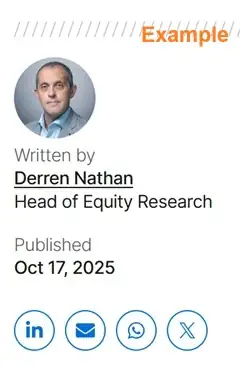
- Add a clear face pic – ideally, a professional headshot next to the byline, to make the content feel accountable and personal. This is especially valuable for local financial advisers.
- Connect author to the firm’s local presence – to reinforce local SEO for financial institutions and builds trust with readers searching for nearby experts.
The importance of regulatory compliance
We highly recommend setting up an editorial process that involves internal compliance and/or legal review for all published content. This should be a non-negotiable layer of compliance checking for any expert financial content strategy.
Authoritativeness: How to earn trust signals in regulated markets
Expertise and experience alone are not sufficient to earn trust. People don’t often put their financial wellbeing into the hands of a business or adviser that isn’t perceived as an authority in the field. Google and ChatGPT measure authoritativeness on the basis of links and citations earned.
Securing high-authority backlinks
Building links from respected financial publishers, government and regulatory sites and mainstream news sites is the best way to establish authority. Investing in digital PR rather than ordinary (low quality) link building is very important, because the latter can easily erode brand trust and negatively impact perceived authoritativeness.
 5 simple, effective and compliant ways to secure high-authority links:
- Publish high quality data-driven insights and reports
- Contribute expert commentary to reputable and niche sector-specific publications
- Collaborate with educational or non-profit organisations
- Create useful tools and calculators
- Build partnerships with complimentary financial businesses
Obtaining brand mentions & unlinked citations
As we move beyond SEO, links have diminished in value. AI search optimisation focuses on brand mentions because LLMs often draw on information from authoritative websites and then compile answers based on a number of sources. Third-party validation – earned through PR and media mentions – is trusted more than self-promotion.
Read this article to get more ideas for link building and digital PR in regulated financial markets.
Trustworthiness: What are the key technical and transparency signals?
When it boils down to it, consumers work with brands they trust, especially in YMYL sectors. Even in a world without online search, building trust was and would remain critical for finance businesses.
Mandatory financial disclaimers & disclosures
As mentioned earlier, regulatory compliance is often a requirement for the very existence of certain financial content online. In the UK and Europe regulators go so far as to specify not just what to disclose but where and how disclosures should appear, to ensure they’re clear, prominent, and not misleading.
For instance, the UK FCA (Financial Conduct Authority) does not specify a universal “pixel position”, but it often expects investment risk warnings to appear above the fold, adjacent to the relevant claim or content, and in a readable font and contrasting colour.
Similarly, in the USA, the SEC and FINRA are explicit about disclosure placement, requiring them to be in close proximity to the related claim and appearing “before the consumer makes a decision”, i.e. before the CTA button.
The role of security
Technical trust factors also play a bigger role in the finance industry. Users and crawlers look for trust and security signals such as the use of HTTPS, presence of trust marks, clear privacy policies, and secure data handling, especially on form pages.
Read more about how technical SEO and security impact financial institutions.
Action Plan: Improving your financial E-E-A-T score
In summary, to improve your financial E-E-A-T score:
- Focus on making your credibility visible and verifiable across every customer touchpoint.
- Ensure that every article is written and reviewed by qualified professionals with clear credentials and linked author bios.
- Back up claims with reputable data sources, citing them transparently.
- Showcase real client experience, case studies, and reviews.
- Earn third-party validation, especially from authoritative sites.
- And keep your site secure and compliant.
Content audit for accuracy & freshness
Focus on keeping key information, such as interest rates, regulations, and statistics updated. When implementing E-E-A-T for financial services brands, AccuraCast’s specialists audit not just the website, but also PR and communications to ensure consistency and factual correctness of information relating to the business online.
Optimising key pages
An often forgotten, but important part of E-E-A-T is making the company’s and author’s information consistent on about us, team pages, and author pages. highlighting accreditations, awards, and organisational structure also helps.
If you need to build trust and boost your site’s E-E-A-T score, we are the right finance SEO agency for you!
About the Authors

Lourenço is a Senior SEO Executive at AccuraCast, responsible for the strategic and tactical elements of Organic channel acquisition. With over 10 years of experience working with international brands for clients in Europe, North and South America.

Ruben is a digital marketing consultant at AccuraCast, in charge of developing and executing effective digital marketing strategies. His specialities include digital strategy, paid media and programmatic for financial services brands.