


by: Paul Bennett and Farhad Divecha
The State of Financial Services Digital Marketing – Key findings from 100+ finance & fintech marketing leaders
The Fin.Tech Marketing Community, in partnership with Accuracast, surveyed 100+ senior marketing leaders globally to understand how the Fintech and Financial Services sector is really navigating the digital marketing landscape.
In our role as the leading international financial services marketing agency, we are committed to helping financial brands make more informed marketing decisions in an increasingly complex digital environment. This research provides a financial services and fintech marketing benchmark for senior marketers seeking to understand industry priorities, challenges, and opportunities for growth.
Key takeaways from the research:
- While 70% say digital performance meets or exceeds expectations, fewer than one in six feel “very confident” in achieving a lasting competitive advantage through tools alone.
- Sales and marketing alignment carries the highest long-term expectation, with 60% expecting high returns.
- Three-quarters (75%) of respondents use AI regularly across marketing functions, yet 44% operate without a formal integration strategy.
- Gains from AI are heavily weighted toward top-of-funnel activity involving content volume, production speed, and audience targeting.
- Answer Engine Optimisation (AEO) is the most actively planned new investment for 2026.
- Audience trust risks due to AI use are factored into 50% of respondents’ governance policies.
Digital marketing is delivering, but leaders remain cautious
Most marketers who participated in the research say digital marketing is meeting or exceeding expectations. Despite the positive performance, confidence in achieving lasting competitive advantage is quite low. As a fintech marketing agency operating in the sector, we have seen CPCs rise steadily, and expectations growing, while budget remain under pressure. This could lead to the lack in confidence seen here.
It’s interesting to see paid search, organic search and paid social are currently, and are expected to remain, the primary or supporting drivers of acquisition, while owned channels, email and webinars have dropped in perceived value.
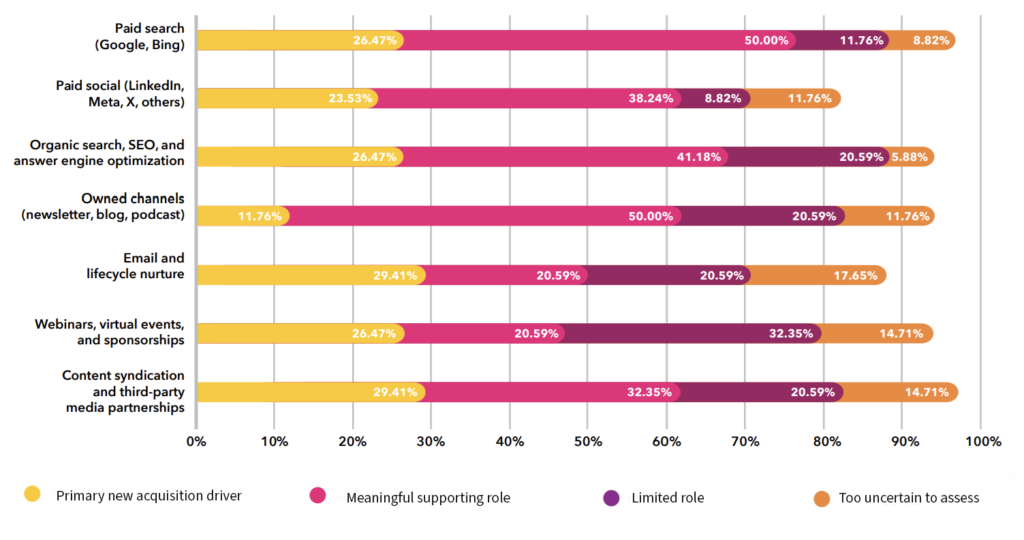
AI tools have become widely accessible, reducing their value as a differentiator. Execution quality increasingly matters more than technology adoption. The full report reveals where marketers are seeing the strongest results, and which areas are perceived to be underperforming.
How AI is used in financial services marketing
Unsurprisingly, AI is now part of day-to-day marketing operations for most teams. However, its use skews towards the top of the marketing funnel and in analysis, whereas governance and strategic integration lag behind implementation.
| Marketing metric | Perceived positive AI impact |
|---|---|
| Speed and volume of marketing output | 23.1% |
| Quality and relevance of audience targeting | 25.6% |
| Pipeline velocity & conversion rates | 10.3% |
| Customer acquisition costs | 10.2% |
Financial marketing trends have kept pace with other industries. It’s fair to say that AI adoption is running ahead of organisational maturity. Roughly 75% of marketing leaders reported that AI is embedded across multiple marketing functions or is used consistently in several areas
Search is evolving faster than marketing playbooks
Answer Engine Optimisation (AEO, aka GEO) is emerging as one of the most actively discussed investment priorities for financial services and fintech marketing teams.
Accuracast is a fintech SEO & AEO agency with over two decades of experience helping finance scale-ups improve organic search visibility. In the early days of search, we found traditional financial services brands lagged behind on SEO adoption. Today, with the growth in popularity of AI as a conversational and search interface, we see rapid growth in AI search optimisation interest among fintechs and B2B financial service providers.
The rapid pace of change in the AI industry requires an experimentative approach, with firms testing tools, tactics and methodology before proving ROI. Savvy marketing leaders have recognised the opportunity and are positioning for future search behaviour, rather than waiting for complete evidence. The report identifies which search-related capabilities marketers are prioritising for 2026 and beyond.
Read our ultimate guide to SEO for Financial Services.
International growth still requires more than digital channels
The report finds that digital channels primarily support international expansion as part of a hybrid strategy: 56% combine digital and traditional tactics for overseas markets, while fewer than 20% rely exclusively on digital marketing.
When asked, “How well does digital marketing support your efforts to grow your business internationally?”, the responses were as shown in the graph below:
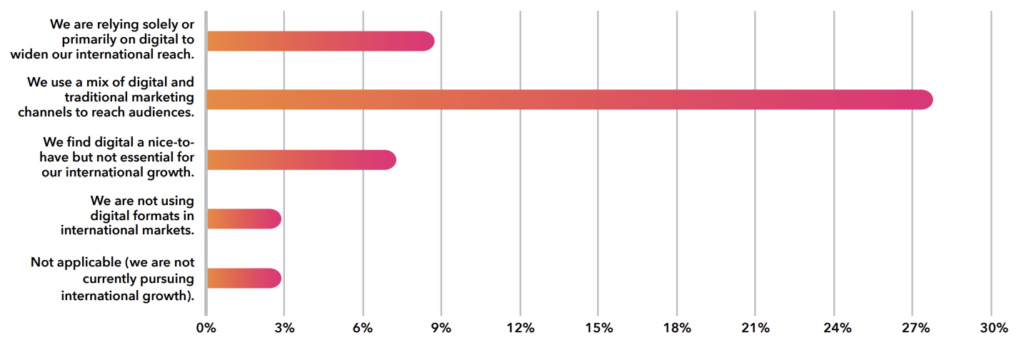
Digital marketing plays a major role in international expansion. Most firms favour a hybrid model that combines digital and traditional approaches, this could be because certain formats such as out of home or TV are considered “premium” and can build trust faster. For B2B financial services marketing, in-person events are still extremely important.
It’s important to add that effective localisation remains critical, especially in this YMYL (your money, your life) industry, where trust is extremely important. Localisation goes beyond just translation. International growth requires market-specific execution, rather than simply scaling campaigns globally. For example, a fintech firm scaling in Germany may need to emphasise compliance and security rather than innovation, and a wealth management brand entering the UAE may find relationship-driven channels are more important than digital.
Learn how to create an international growth strategy.
The AI governance gap may be the biggest risk
Brand credibility and audience trust have become governance priorities. Many organisations now explicitly assess AI-related trust risks. Yet, almost as many organisations still lack formal ownership, policies and measurement frameworks for AI use.
As organisation accelerate deployment, management processes are falling further behind. Formal KPIs are not yet universal, and measurement approaches remain inconsistent. This creates operational risk.
Governance, accountability and auditability are becoming strategic priorities especially in regulated markets for finance.
Summary: What high-performing financial services marketers should be focusing on next
The full research report can be downloaded here:
The State of Digital Marketing in Financial Services 2026
The financial services marketing agency team at Accuracast worked closely with the Fin.Tech Marketing Community on the survey this report is based on, as well as the insights included in the report. If asked to summarising the key strategic takeaways from the report, we’d say:
- Focus on execution quality rather than tool acquisition
- Invest in audience insight and targeting precision
- Build trust into AI governance
- Improve attribution and measurement
- Prepare for (and stay on top of) AEO and AI-driven search
- Create formal governance structures.
About the Authors

Paul is CMO of the Financial Services practice at AccuraCast. During a 25 year career at AXA, as Global Brand Director, he undertook a complete transformation of the brand, taking it from an institutional brand to a top 3 global Financial Services brand. He then oversaw the rapid European growth of Huboo. Paul is an expert in brand building and a trained marketer and holds a Chartered Institute of Marketing Diploma.

Farhad is the Group CEO of AccuraCast. With over 20 years of experience in digital, Farhad is one of the leading technical marketing experts in the world. His specialities include digital strategy, international business, product marketing, measurement, marketing with data, technical SEO, and growth analytics.